
Eliminating Operational Bottlenecks: How Managed IT Services Improve Enterprise Operations
Eliminating Operational Bottlenecks: How Managed IT Services Improve Enterprise Operations
As enterprise operations scale across multiple locations, their technology environment becomes harder to manage. Networks, servers, cloud platforms, business applications, databases, APIs and connected devices all need to work together. A problem in any one layer can quickly affect users, customers or day-to-day operations.
This is becoming more important in India as technology investment continues to grow. Gartner forecasts India’s IT spending to reach US$176.3 billion in 2026, up 10.6% from 2025. IT services alone are forecast at about US$35.4 billion, growing 11.1%. The same forecast points to continued investment in application modernization, connectivity, automation and infrastructure. (Source: Gartner, November 2025.)
For organisations, the question is no longer only whether the infrastructure is available. The real requirement is to keep the complete technology environment reliable, visible and manageable while allowing internal teams to focus on business priorities.
The Core Operational Challenges in Hybrid IT Environments
Operational bottlenecks usually develop across several technology layers, not only within infrastructure.
- Infrastructure and Connectivity Issues: A server, network device, internet link or remote-site connection can affect ERP access, production systems, branch operations and customer-facing services.
- Application, Database and Integration Issues: Infrastructure may be healthy while an application, database, API or background process is slow or unavailable. These issues still affect business users and need the same operational visibility as servers and networks.
- Engineering Resource Depletion: Internal teams often spend significant time on routine monitoring, patching, ticket resolution and repeated troubleshooting. This reduces the time available for modernization, automation and new business initiatives.
- Multi-Vendor Friction: Modern environments may involve separate providers for connectivity, cloud, hardware, applications and databases. During an incident, unclear ownership can delay diagnosis and resolution.
- Cloud and Configuration Complexity: As organisations add cloud services and distributed workloads, inconsistent configurations, unused resources and fragmented monitoring can create unnecessary cost and operational risk.
Strategic Solution: Integrated Managed IT Operations
Nextnode Managed Services is designed to bring infrastructure, cloud, applications and service operations into a more structured support model. The objective is to identify issues earlier, coordinate response faster and reduce the operational load on internal teams.
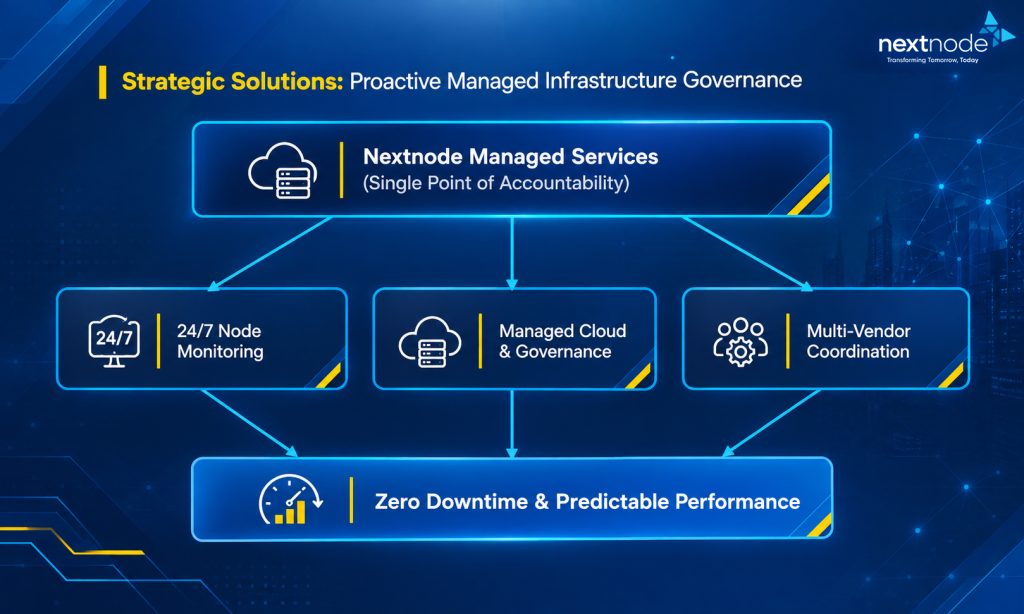
- Proactive 24/7 Infrastructure and Application Monitoring
Monitoring should cover more than server health. Nextnode can monitor network availability, compute resources, cloud workloads, business applications, databases, APIs, integrations and connected edge devices based on the customer environment. Alerts and thresholds help teams identify abnormal behaviour before it develops into a larger business incident.
- Managed Cloud, Application and Database Operations
Consistent performance requires day-to-day operational discipline. This includes configuration management, patching, capacity and resource monitoring, backup checks, application health, database performance and coordination of planned changes. The aim is to reduce avoidable variation and keep critical systems operating within agreed service levels.
- Incident, Problem Management and Automation
Closing a ticket is only one part of service management. Recurring incidents need root-cause analysis, corrective action and follow-up. Automation can also be introduced for repetitive checks, alerts, reporting and selected operational tasks so that engineers spend less time on manual activity and more time on improvement work.
- Single-Point Vendor Coordination
When an issue crosses network, cloud, hardware or software boundaries, Nextnode can act as a central coordination point. This gives the customer one operational view while the relevant ISP, cloud provider, OEM or application team is engaged through the agreed escalation process.
- IoT, Edge and Private Connectivity
For industrial and distributed environments, Nextnode can also support IoT gateways, edge systems and private enterprise connectivity where these technologies are relevant. This helps organisations bring operational data from devices and field environments into the same monitoring and service-management framework.
How Nextnode Helps Improve the Organisation
The value of managed services should be visible in business operations, not only in the IT department. By combining operational support with engineering and automation, Nextnode helps organisations improve the way technology supports day-to-day work.
- Better operational visibility: A clearer view of infrastructure, applications, connectivity and service health helps teams understand where problems are developing.
- Faster issue resolution: Defined monitoring, escalation and vendor coordination reduce the time lost in identifying who needs to act.
- Reduced routine workload: Automation and structured support can reduce repetitive checks, reporting and recurring operational tasks.
- More productive internal IT teams: Internal teams can spend more time on business applications, modernization and improvement instead of continuous firefighting.
- Better decision-making: Operational dashboards and service reports can show trends, recurring incidents, capacity issues and areas requiring investment.
- Support for growth: A structured operating model can scale as the organisation adds users, applications, locations and connected devices.
Measurable Business Outcomes
Managed services should be measured against the customer’s own baseline and agreed SLA rather than generic marketing percentages. Typical measures include:
| Operational Area | What to Measure | Expected Improvement |
| Availability | Service uptime against agreed SLA | More consistent availability and fewer unplanned disruptions |
| Incident Management | Mean time to acknowledge and resolve (MTTA/MTTR) | Faster detection, escalation and recovery |
| Recurring Problems | Repeat incidents and root-cause closures | Fewer repeated operational issues |
| Applications & APIs | Response time, errors, failed jobs and integration health | Better user experience and process continuity |
| Cloud & Infrastructure | Capacity, utilisation, patching, backup and resource exceptions | Better control, consistency and resource use |
| Vendor Coordination | Escalation time and dependency ageing | Clearer ownership and faster follow-up |
| Internal IT Focus | Routine support load versus improvement work | More time for modernization and strategic initiatives |
India’s managed infrastructure market also reflects this shift. Frost & Sullivan estimates that India’s IT Infrastructure Managed Services market (ITSM/ESM plus Infrastructure Management Services) was about US$1.65 billion in 2024 and is forecast to reach about US$3.47 billion by 2030. (Source: Frost & Sullivan analysis reproduced in a 2025 SEBI filing.)
Build a More Reliable and Scalable Technology Environment
Operational stability should not depend on how quickly teams react after a failure. It comes from visibility, disciplined service management, coordinated ownership and continuous improvement across infrastructure and applications.
Nextnode helps organisations move from managing individual technology problems to managing technology as an integrated business service. The focus is practical: improve reliability, reduce operational complexity, give internal teams better visibility and create a technology environment that can support future growth.
Learn more about Nextnode Managed Services at www.nextnodesolutions.com.
Sources
Find What Matters To You
What is your next IT project for which you need a team now?
Explore the evolution of our Vision,
Innovation, and Sustainable Progress.
Eliminating Operational Bottlenecks: How Managed IT Services Improve Enterprise Operations
As enterprise operations scale across multiple locations, their technology environment becomes harder to manage.

PRIVATE 5G (CNPN) | THE NEXT DIGITAL INFRASTRUCTURE
The future of enterprise connectivity is moving beyond conventional networks.
The Shift to AI-Powered Command Centers in Urban Infrastructure
How Intelligent Command Centers Are Building Safer, Smarter, and More Resilient Cities

How Private 5G Is Transforming Industrial Connectivity
Industrial enterprises are entering a new era where connectivity is no longer just an IT requirement.

Smart City Solutions – Transforming Urban Living with Technology
As cities across the globe expand at an unprecedented rate, urbanization is reshaping the way we live, work, and move.

Designing Scalable IT Infrastructure for Growing Businesses
In the digital-first economy, growth can happen fast-and so should your infrastructure.