
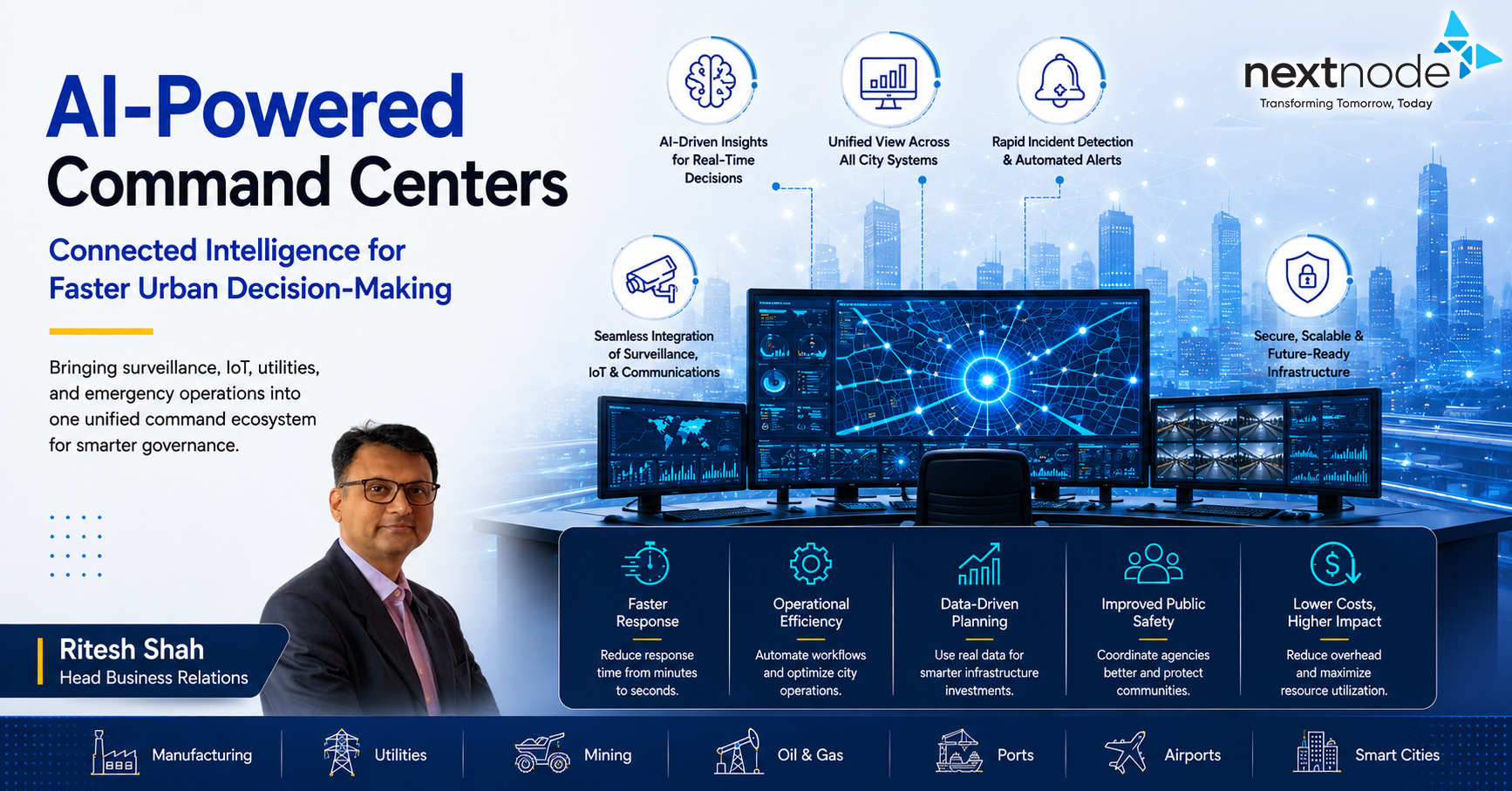
The Shift to AI-Powered Command Centers in Urban Infrastructure
How Intelligent Command Centers Are Building Safer, Smarter, and More Resilient Cities
Modern cities generate massive amounts of data every second. Traffic lights send updates to central servers, security cameras scan intersections, environmental sensors track air quality, and municipal utilities stream live operational metrics. Yet, most city governments process this data inside isolated silos.
Traffic teams monitor road congestion. Dispatchers handle emergency calls. Water and power engineers manage utilities. Each group relies on its own software, separate databases, and closed communication tools.
That setup worked 20 years ago. Today’s growing urban centers need connected systems that react instantly. The future of city management relies on AI-powered Integrated Command and Control Centers (ICCCs).
Nextnode Solutions helps Governments and municipal authorities design and integrate these AI-powered ICCCs by connecting surveillance, IoT, utilities, communication networks, and emergency response systems into one secure, real-time command environment.
The Challenge with Isolated Control Rooms
Managing urban infrastructure has gotten complicated. Cities now oversee thousands of connected points: signal controllers, public transport fleets, street lights, water mains, and emergency networks. When these systems operate independently, decision-making grinds to a halt during crises.
Take a multi-car crash during peak rush hour:
- Traffic operators spot backing-up cars on their monitors.
- Citizens call 911, giving dispatchers location details.
- Police send units based on limited initial reports.
- Engineers manually adjust signal timing to clear lanes.
- Hospitals wait for updates without direct links to field teams.
Because departments work in isolation, response times drag, traffic backs up for miles, and public safety risks increase. Fragmented management simply breaks down as city populations scale.
How AI-powered ICCCs transform city operations
Integrated Command and Control Centers change how municipalities run daily operations. Instead of running separate departments, an AI-powered ICCC connects all city systems into a single live dashboard.
The platform ingests live feeds from multiple infrastructure points:
- CCTV security cameras and traffic sensors
- Industrial and municipal IoT monitors
- Smart streetlights and signal systems
- Transit fleets and utility networks
- Emergency dispatch systems and air quality monitors
Artificial intelligence parses this inbound data continuously. It flags anomalies, predicts bottlenecks, and suggests immediate steps. Instead of forcing operators to sift through hundreds of alarms manually, the system flags critical events and coordinates a response right away.
In many smart city deployments, these data flows depend on resilient communications infrastructure such as secure fiber, mission-critical wireless networks and private 5G or CNPN-ready architectures. Nextnode Solutions brings system integration expertise across command center platforms, field devices, communications and security layers so that every component works together reliably in real-world Government environments.
Smarter emergency response in practice
Consider how an integrated platform handles a severe intersection collision:
- Identify the crash: Video analytics detect abnormal vehicle movement and flag a probable crash on a nearby camera within seconds.
- Confirm impact: The platform cross-checks traffic sensor data to verify sudden speed drops and growing congestion.
- Automate response: Instead of relying on phone trees, the platform alerts police, fire, and medical teams at the exact same time.
- Clear green corridors: The system adjusts nearby traffic lights automatically, opening a clear route for approaching ambulances.
- Reroute drivers: Digital street boards and navigation apps receive auto-updates directing commuters away from the crash site.
Tasks that used to require dozens of calls and manual steps now happen in seconds. Response times drop, clearing scenes faster and saving lives.
Upgrading General Urban Services
AI command centers do far more than manage traffic. Unifying city data gives administrators complete control over everyday operations. For instance, AI algorithms can flag:
- Water pipe leaks before mains burst
- Power grid glitches before widespread blackouts hit
- Security breaches at critical city facilities
- Spikes in air pollution across targeted neighborhoods
- Dangerous crowd density during public gatherings
- Flooding risks during heavy downpours
City teams stop reacting to disasters after they happen. Instead, they use live operational data to fix small issues before they escalate.
Cutting Operational Overhead
Managing ten separate software platforms across municipal offices burns through budgets. It creates duplicate work and leads to messy reporting.
A unified command center streamlines operations through:
- Single-screen monitoring dashboards
- Shared data access across departments
- Automated incident escalation protocols
- Standardized reporting and asset tracking
This structure cuts administrative bloat and lets municipal teams focus on core tasks instead of fighting disconnected software.
Data-Backed Urban Planning
Beyond daily monitoring, command centers supply long-term operational trends. Historical data from traffic feeds, utility usage, and emergency logs gives city leaders concrete facts for future investments.
Urban planners can pinpoint recurring bottlenecks, forecast power demand, optimize bus routes, and schedule road repairs based on actual usage numbers. Cities allocate tax dollars based on measurable proof rather than guesses.
Building Smart Infrastructure with Nextnode Solutions
Connecting city infrastructure is no longer a luxury for modern municipalities. NextNode Solutions helps city governments design, deploy, and scale AI-powered Integrated Command and Control Centers.
We integrate surveillance feeds, IoT sensors, utility grids, emergency networks, and custom analytics into a secure ecosystem. Our system integration work ensures every hardware and software component works together reliably.
Whether your priority is cutting emergency response times, boosting public safety, or modernizing utilities, NextNode Solutions provides the integration expertise you need to run complex cities with confidence.
Conclusion
Collecting urban data is easy. Making that data actionable is what matters. AI-powered Integrated Command and Control Centers break down departmental walls, speeding up emergency response and making city services reliable.
For municipalities aiming to build safer, more resilient urban centers, investing in an integrated command center is a practical necessity today.
With the right system integration partner, cities can move from fragmented monitoring to connected, data-driven governance. Nextnode Solutions enables that transition by bringing together infrastructure, intelligence, and operational control into one unified command framework.
Find What Matters To You
What is your next IT project for which you need a team now?
Explore the evolution of our Vision,
Innovation, and Sustainable Progress.
The Shift to AI-Powered Command Centers in Urban Infrastructure
How Intelligent Command Centers Are Building Safer, Smarter, and More Resilient Cities
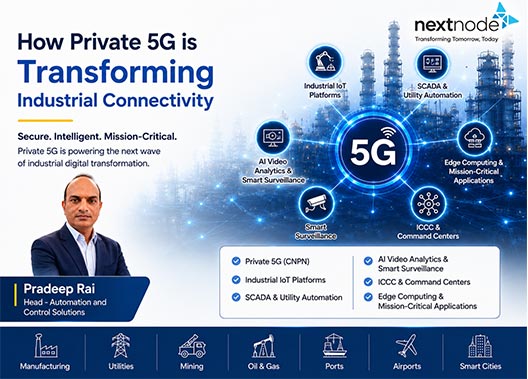
How Private 5G Is Transforming Industrial Connectivity
Industrial enterprises are entering a new era where connectivity is no longer just an IT requirement.
Smart City Solutions – Transforming Urban Living with Technology
As cities across the globe expand at an unprecedented rate, urbanization is reshaping the way we live, work, and move.

Designing Scalable IT Infrastructure for Growing Businesses
In the digital-first economy, growth can happen fast-and so should your infrastructure.